


When your body no longer feels the same: Understanding midlife's physical changes and what they’re inviting you towards
- Phil McAuliffe

- May 3
- 5 min read
Updated: May 4
At some point in midlife, your body starts to change in ways you can’t ignore.
This article explores what those midlife changes mean, and how to respond.

Hello my friend
I’m currently 49 years old. I’m oddly proud of the fact that I can still run faster than our almost-19-year-old sons.
This boast may not still apply by the time you read these words. But be assured that I’m hanging onto it for as long as I can.
I’ve noticed my body changing over the past year. I’ve been recovering from a bunion on my right big toe that made it painful to walk, run and swim, a lower back injury that made it painful to sit, and the recurrence of a shoulder injury from my competitive swimming days that made it painful to lift anything over my head.
A bunion. I mean, it’s almost comical, isn’t it?
I’ll add to this that my skin has gone to sh*t, and I can’t speak without having to clear my throat first. Grey hair is rapidly crowding out the others – and refuses to be tamed into any kind of order – and my eyesight has changed to the point where my glasses are simply props.
I’m confident that you also have a similar list.
How are you handling these physical changes?
I still love to exercise and challenge my body by lifting weights, running and – when I can – swimming. I continue to feel fitter now than I did in my early 20s.
But I fell into the trap of trying to maintain performance and appearances by working out in the same way that I did in my 20s.
I didn’t prepare my body for activity through warming-up or stretching. I didn’t allow my body time to recover. I took sleep for granted and told myself that I was fully rested with the usual 6 hours of sleep I was getting (I wasn’t…)
The injuries were the sign that I needed to review how I was moving through the world in my body if I was to do so in the way I wanted to in the second half of my life.

Beyond physical injuries, you may be contending with shifting hormones that signal perimenopause or your social feeds are like mine, selling you products to boost your testosterone.
Our once-reliable bodies are now unfamiliar terrain.
How are you responding to these changes? Are you doing what I’ve done? Have you been pushing harder, ignoring the niggles and trying to maintain the pace from a few years ago?
Do you also look at photos of yourself from the past and think, ‘I want to get back to that’?
Are you considering – or getting – cosmetic enhancements?
Are you working hard to prove that nothing has changed?
There’s no judgement here, only this question: To whom are you trying to prove this?
The realisation
We reach a point when we realise that the previous physical version of ourselves has gone and we’re now evolving into something – someone – else.
This is a tough realisation. There’s a type of mourning that those days are not going to return, no matter what changes we make.
It’s confronting to look forward into our future and know that this shift will continue.
It’s all so irreversible.
The internal conflict
I frequently need to pause and think about how old I am. In my head I still think that I’m 25 years old.
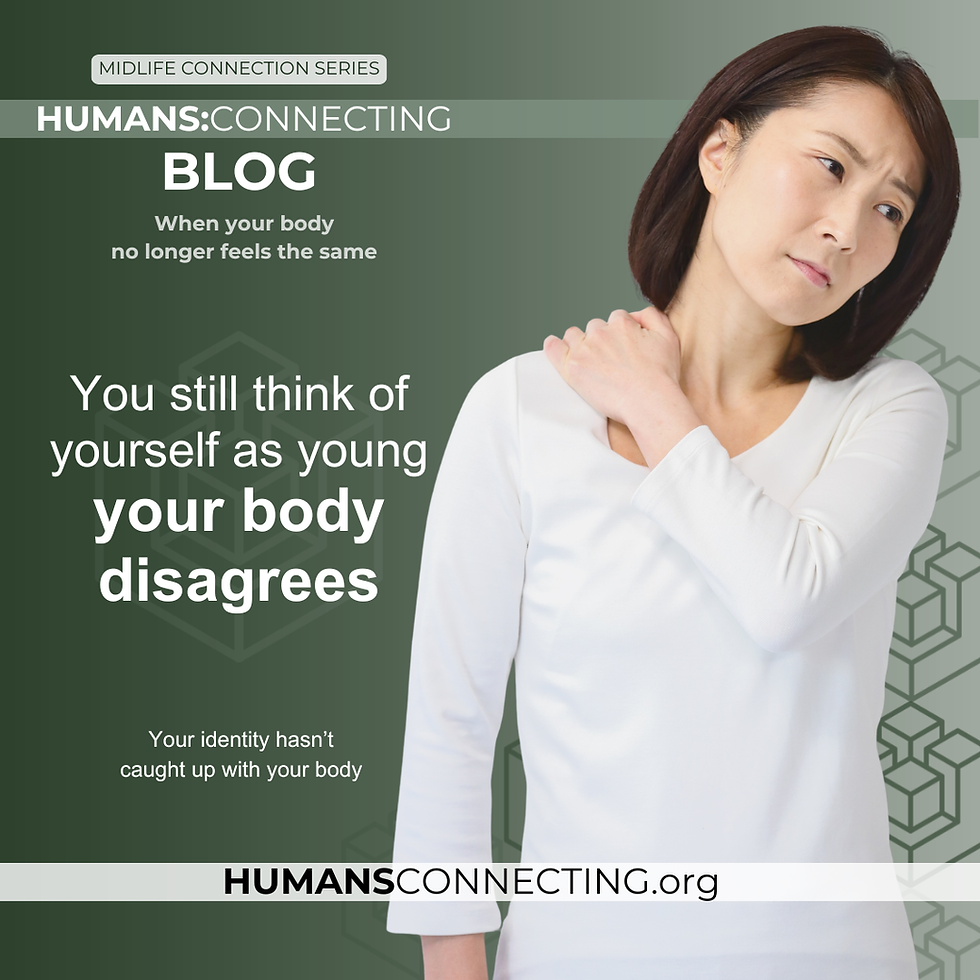
I still see myself as being young, then I look in the mirror and see my face. I see my hands. They’re ageing.
No matter what I do, things won’t come back the way they once used to. The way I took for granted.
The head/body mismatch
I was the youngest in the room and around conference tables for much of my career. I felt a certain pride at being that person who was on the fast track to success and status by virtue of being young in a room full of older people.
Now I’m the age that the ‘older people’ were when I was younger. I look at the younger people at the table I’m sitting at, and I marvel at their energy and – honestly – tut-tut at their naïveté.
All while I still think that I’m that age. But the body does not agree.
The invitation to respond
I could chase my youth. I could still exercise hard. I could work hard.
But that’s not what I need. Pushing harder will bring injury and frustration.
But slowing down and accepting who and how I am also brings its own kind of frustration.

So I get to choose my frustration. I get to accept that my body is inviting me to evolve with it. It’s inviting me to adjust my life to meet it.
My body isn’t betraying me. It’s leading me to where I must be in the next phase of life.
My body is inviting me to more meaningful connection with my authentic self. Movement and nutrition are still important, but maybe more walks are needed rather than 15km runs. Maybe a 20-minute nap will serve me more than a fourth coffee (which would have me flirting with heartburn recklessly).
The aim is to feel good in my body and to work with it to sustain me in the next phase of life.
Reflection
As we navigate midlife, I invite us to reflect on how our bodies are evolving.
What changes have you noticed as you move into - and through - midlife?
Can you accept your body as it is?
Rather than pushing through and working against it, how can you begin working with it?
Can you see your body as your only vehicle through life and celebrate and respect them for how it sustains you?
What needs to change so you feel more meaningfully connected to your authentic self - physically, mentally and emotionally?
A place to start
If something in this article resonates, it may be pointing to a deeper question: what kind of connection is meaningful to you?
The Connection Starter Course helps you understand the quality of your connections and take practical steps to strengthen meaningful connection in your life.
You’ll develop your personal Connection Plan — a practical way to get the connection that’s meaningful for you.
~ Phil

FROM THE H:C STORE
Important:
All views expressed above are the author’s and are intended to inform, support, challenge and inspire you to consider the issue of loneliness and increase awareness of the need for authentic connection with your self, with those most important to you and your communities as an antidote to loneliness. Unless otherwise declared, the author is not a licensed mental health professional and these words are not intended to be crisis support. If you’re in crisis, this page has some links for immediate support for where you may be in the world.
If you’re in crisis, please don’t wait. Get support now.


Comments